|
Akshrabhyasam (Aksrabhyasam, Akshrabyasam, Vidyarambham)
The initiation of a child into the formal learning process is usually
done between the 2nd and the 4th year of the child. The child participates
in the Saraswati pooja as the priest recites the mantras. The child
is then made to write sacred letter Om .
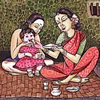 Anna-prasanam is a traditional ceremony of initiating solid
food to a child. Food is first offered to God. Then the paternal
grandmother mixes boiled rice and milk in a silver bowl and feeds
the child. Then a book, gold chain, pen and a knife are placed on
a small wooden table. The child is then left free 15 yards (14 m)
away from the table. As the child moves towards the table, he or
she is believed to become associated with whichever of the four
articles that he or she touches.
Anna-prasanam is a traditional ceremony of initiating solid
food to a child. Food is first offered to God. Then the paternal
grandmother mixes boiled rice and milk in a silver bowl and feeds
the child. Then a book, gold chain, pen and a knife are placed on
a small wooden table. The child is then left free 15 yards (14 m)
away from the table. As the child moves towards the table, he or
she is believed to become associated with whichever of the four
articles that he or she touches.
Atla
tadde is a traditional festival celebrated by married
Hindu women of Andhra region in Andhra Pradesh, India, for the health
and long life of their husbands. It occurs on the 3rd night after
the full moon in Aswiyuja month of Telugu calendar, and falls in
either September or October in the Gregorian calendar. It is the
Telugu equivalent of Karva Chauth, which is celebrated by north
Indian women the following day.
Avadhanam
is a literary performance popular from the very ancient days in
Sanskrit and more exclusively in Telugu language. It requires immense
memory power and tests a person's capability of performing multiple
tasks simultaneously. All the tasks are memory intensive and demand
an in depth knowledge of literature, and prosody. The tasks vary
from making up a poem spontaneously to keeping a count of a bell
ringing at random. No external memory aids are allowed while performing
these tasks except the person's own brain.
Barasala (Naam Karanam) is a traditional ceremony
that is performed on the eleventh day after a baby birth, the child
is given a name. It is during this ceremony that for the first time
relatives and close friends see the child. It is a small ceremony
where invitees sing songs and celebrate the arrival of the child.
The name is written on rice spread on the floor or on a tray. The
child's maternal uncle takes a golden ring and keeps it on the child's
mouth. The mother and both the grandmothers give gold to the child
(either a chain or a bangle).
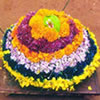 Batukamma
is a spring festival celebrated by the Hindu women of Telangana
region in Andhra Pradesh, India. It is also called as Bodemma. This
festival falls in the months of September/October called as Aswiyuja
and concludes two days before Dussera called as Durgashtami. Batukamma
is a beautiful flower stack, arranged with seasonal flowers, in
seven concentric layers, of potter’s clay like a cone. Batuku
in Telugu means live/life, and Amma means mother, hence Batukamma,
is celebrated for the glory of Gauri goddess (meaning fair or white)
- the patron Goddess of womanhood. Women celebrate the festival
dressed-up in traditional silk sarees, wear jewellery and girls
wear a two-piece saree called as Langa oni. Batukamma
is a spring festival celebrated by the Hindu women of Telangana
region in Andhra Pradesh, India. It is also called as Bodemma. This
festival falls in the months of September/October called as Aswiyuja
and concludes two days before Dussera called as Durgashtami. Batukamma
is a beautiful flower stack, arranged with seasonal flowers, in
seven concentric layers, of potter’s clay like a cone. Batuku
in Telugu means live/life, and Amma means mother, hence Batukamma,
is celebrated for the glory of Gauri goddess (meaning fair or white)
- the patron Goddess of womanhood. Women celebrate the festival
dressed-up in traditional silk sarees, wear jewellery and girls
wear a two-piece saree called as Langa oni.
Bhynlollu is a Telugu tribe/caste mainly lives
in Telangana region. They are famous for playing a special type
of drum makes very funny Budunku Budunku sound. They also lead some
local festivals like Mahankali, Yellamma and Maisamma festivals.
Bogi Mantalu The Bonfire ritual observed on the
eve of Bhogi festival. The significance of the bonfire, in which
is burnt the agricultural wastes and firewood is to keep warm during
the last lap of winter. Girls dance around the bonfire, singing
songs in praise of the gods, the spring and the harvest.
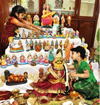 Bommala Koluvu is the display of various dolls
and toys on Sankranthi festival day. Bommala means toys’ and
Koluvu means durbar. Like the kings' durbar, a variety of dolls
are arranged beautifully in a selected place of the house and displayed
to all the guests who come to see it. Bommala Koluvu is the display of various dolls
and toys on Sankranthi festival day. Bommala means toys’ and
Koluvu means durbar. Like the kings' durbar, a variety of dolls
are arranged beautifully in a selected place of the house and displayed
to all the guests who come to see it.
Bommarillu (Toys House) is a small mud house build
by kids usually on Sankranthi festival day and decorate it with
colors and toys. (There is a Telugu movie with this title).
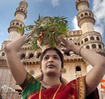 Bonalu
is a festival for the Goddess of power, Mahakali or Kali, celebrated
in Hyderabad, Secunderabad and parts of Telangana and Rayalaseema
in India. It is more like carnival then a traditional hindu festival.
The festival environment is quite palpable in the locality celebrating
the festival, with loud-speakers playing Mother Goddess songs in
folk style, and streets are decorated with neem leaves. Bonam means
a meal in Telugu, is an offering to the Goddess. Women bring cooked
rice in a brass or earthen pot, adorned with small neem branches
and turmeric, vermilion (kunkum) or Kadi (white chalk) and a lamp
on the top. Women place the pots on their heads and take it to Goddess
temple, led by drummers and dancing men. Bonalu
is a festival for the Goddess of power, Mahakali or Kali, celebrated
in Hyderabad, Secunderabad and parts of Telangana and Rayalaseema
in India. It is more like carnival then a traditional hindu festival.
The festival environment is quite palpable in the locality celebrating
the festival, with loud-speakers playing Mother Goddess songs in
folk style, and streets are decorated with neem leaves. Bonam means
a meal in Telugu, is an offering to the Goddess. Women bring cooked
rice in a brass or earthen pot, adorned with small neem branches
and turmeric, vermilion (kunkum) or Kadi (white chalk) and a lamp
on the top. Women place the pots on their heads and take it to Goddess
temple, led by drummers and dancing men.
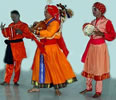 Burrakatha
is a story-telling technique used in villages of Andhra Pradesh.
The troupe consists of one main performer and two co-performers.
It is a narrative entertainment consists of prayers, solo drama,
dance, songs, poems and jokes. The topic will be either a hindu
mythological story or a contemporary social problem. Burrakatha
is a story-telling technique used in villages of Andhra Pradesh.
The troupe consists of one main performer and two co-performers.
It is a narrative entertainment consists of prayers, solo drama,
dance, songs, poems and jokes. The topic will be either a hindu
mythological story or a contemporary social problem.
Chandamama
is a popular Telugu monthly magazine for children known for its
illustrations. The stories embedded in the never-ending story of
King Vikramaditya and Betala (Vampire), an adoptation of an ancient
Sanskrit work Betala Panchvimshati, brought wide repute to this
magazine.
Cradle Ceremony (21st Day, Uyyalalo Veyadam) is
a Telugu traditional ceremony celebrated on the 21st day of childbirth.
Usually a new silk cloth is put in the cradle and it is decorated
with flowers. At the auspicious time, the mother or the grandmother
places the child in the cradle. All the guests bless the child and
give gifts to the child. The ceremony usually end with lavish dinner
party.
Gadapa (Kadapa) is a horizontal wooden piece
at the bottom of the main door. Telugu people give special importance
to it and decorate it with turmeric and with color paintings.
Gajulu (Gaju, Chudi, Bangles,
Kankanalu) are circular in shaped traditional ornaments worn by
Telugu and South Indian women They are made of numerous precious
as well as non-precious materials such as gold, silver, platinum,
glass, wood, rubber, plastic, etc. They are usually worn in pairs
by women, one or more on each arm. Most Indian women prefer wearing
either gold or glass bangles or combination of both.
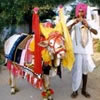 Gangireddu
(Dudu Basavanna) The ceremonial bull decorated for door-to-door
exhibition during the harvest festival Sankranti. Gangireddu is
decorated with beautiful clothes and ringing bells. Haridasulu are
the people of a cast who are dedicated to receive charities from
other people. Haridasu makes gangireddu (bull) to dance. Haridasu
sings songs and gangireddu dances according to his master’s
song. Gangireddu
(Dudu Basavanna) The ceremonial bull decorated for door-to-door
exhibition during the harvest festival Sankranti. Gangireddu is
decorated with beautiful clothes and ringing bells. Haridasulu are
the people of a cast who are dedicated to receive charities from
other people. Haridasu makes gangireddu (bull) to dance. Haridasu
sings songs and gangireddu dances according to his master’s
song.
Gandham (Ghandham, Sandal) has special importance
in Telugu culture. Gandham is usually prepared by rubbing the sandal-wood
on a stone-table (saana) with water. Gandham is offered to Gods
in poojas (prayers) . Women especially in Telangana region applies
Gandham under their chins and hands in parties and functions.
Gilli
Danda(Guli Danada, Chirra Gone, Burra Gone, Gutom Billa,
Pillangodu) is an amateur sport, popular in Telangana region of
Andhrapradesh. The game is played with a gilli or guli and danda,
which are both wooden sticks. The danda is longer and handmade by
the player, who can swing it easily. The gilli is smaller and is
tapered on both sides so that the ends are conical. The gilli is
analogous to a cricket ball and the danda is analogous to a cricket
bat.
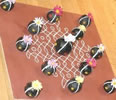 Gobbemmalu
are cow dung balls which are kept on Muggu (Rangoli), which is designed
to invite prosperity and bliss into the house. Gobbemmalu are decorated
with pasupu (turmeric powder), Kumkuma (red vermion powder) and
with several grain types. They are also decorated with flowers (garlands). Gobbemmalu
are cow dung balls which are kept on Muggu (Rangoli), which is designed
to invite prosperity and bliss into the house. Gobbemmalu are decorated
with pasupu (turmeric powder), Kumkuma (red vermion powder) and
with several grain types. They are also decorated with flowers (garlands).
Gorintaku (Mehndi, Henna) is the application of
Henna as a temporary form of skin decoration. Henna is typically
applied during special occasions like weddings and festivals. It
is usually drawn on the palms and feet, where the color will be
darkest because the skin contains higher levels of keratin which
binds temporarily to lawsone, the colorant of henna. Henna was originally
used as a form of decoration mainly for brides.
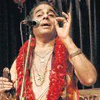 Harikatha
is a composite art form comprising of story telling, poetry, music,
drama, dance, and philosophy. Harikatha involves the narration of
a story, intermingled with various songs relating to the story.
Usually the narration involves numerous sub-plots and anecdotes,
which are used to emphasise various aspects of the main story. The
main story teller is usually assisted by one or more co-singers,
who elaborate the songs and a Mridangam accompanist. The storyteller
uses a pair of cymbals to keep beat. Harikatha
is a composite art form comprising of story telling, poetry, music,
drama, dance, and philosophy. Harikatha involves the narration of
a story, intermingled with various songs relating to the story.
Usually the narration involves numerous sub-plots and anecdotes,
which are used to emphasise various aspects of the main story. The
main story teller is usually assisted by one or more co-singers,
who elaborate the songs and a Mridangam accompanist. The storyteller
uses a pair of cymbals to keep beat.
Holi
(Vasanthostsavam, Kamuni Pournami) is also called the "festival
of colors". Holi is celebrated at the end of the winter season
on the last full moon day of the lunar month Phalguna (February/March).
Holi is the most vibrant Indian festival, when distinctions of caste,
class, age or gender are set to one side. People have fun by smearing
each other with paint and throwing coloured water at each other,
all done in a spirit of celebration.
Jammi is a ritual performed on Dashara (Dasara)
festival. Jammi is a sacred tree; people believe that Pandavas hide
their weapons on this tree. On Dasara day, all the village people
gather at the Jammi tree, perform pooja to the tree and take the
leaves from the tree and greet their friends and families with Jammi
leaves (In hyderabad the leaves are called bangaram and they use
different tree leaves).
Janapada Geetalu (Janapada Geyalu, Janapadalu, Janapadam)
are folk songs of Telugu people. One of the famous forms of music unlike classical music,
Janapada geyalu are very popular form of music for masses. They are not based on
strict music notation like classical music.
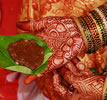 Jeelakarra-Bellam
(Cumin and jaggery) is a ritual especially featuring in the Telugu
marriage, wherein a paste of cumin seeds and jaggery is made. The
bride and the groom apply this paste on each other's hands. The
idea behind applying the cumin seeds and jaggery paste is that the
two different objects coming together and united as one inseparably
and forever. Jeelakarra-Bellam
(Cumin and jaggery) is a ritual especially featuring in the Telugu
marriage, wherein a paste of cumin seeds and jaggery is made. The
bride and the groom apply this paste on each other's hands. The
idea behind applying the cumin seeds and jaggery paste is that the
two different objects coming together and united as one inseparably
and forever.
Kabaddi
(Kabbadi or Kabadi) is a state sport of Andrapradesh. Two teams
occupy opposite halves of a field and take turns sending a "raider"
into the other half, in order to win points by tagging or wrestling
members of the opposing team; the raider then tries to return to
his own half, holding his breath during the whole raid.
Kaalla Pasupu (Feet Turmeric) is a Telugu women
tradition (Mostly in Telangana region) of decorating their feet
with turmeric on special days like festivals and marriages.
Katipapala is a Telugu tribe/caste mainly lives
in Telangana region. They are famous for wearing big gold coloured
crown and wired coloured dresses. Carries a big bell and rings the
bell to indicate their presence in front of your house.
Kite Flying (Gali patalu, Pathang) is very popular
tradition in Hyderabad and Telangana region. Kite flying in Hyderabad
starts a month before the official kite flying festival (Sankranthi).
The thread used to fly kites in Hyderabad is known as 'Manjaa'.
Highly maneuverable single-string paper and bamboo kites are flown
from the rooftops while using line friction in an attempt to cut
each other's kite lines, either by letting the line loose at high
speed or by pulling the line in a fast and repeated manner
Kodi-Pandalu (Rooster fights) is treated as a
cultural game for the festival Sankranthi leaving only either of
the roosters to live. (I personally do not like this. I believe
you should never get happiness out of any animal's suffering) .
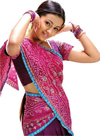 Langa
Oni (Langavoni, Langa voni)is a traditional dress worn
mainly in the states of Andhra Pradesh by young girls between puberty
and marriage. It is also called as two-piece saree or half saree.
The influence of western culture and apparent thought of inconvenience
of wearing the dress has made many girls to switch from this traditional
attire to modern outfits . In recent years, however, Langa Oni is
gaining popularity among girls again due to media attention and
due to the work of many designers who have brought in many new designs. Langa
Oni (Langavoni, Langa voni)is a traditional dress worn
mainly in the states of Andhra Pradesh by young girls between puberty
and marriage. It is also called as two-piece saree or half saree.
The influence of western culture and apparent thought of inconvenience
of wearing the dress has made many girls to switch from this traditional
attire to modern outfits . In recent years, however, Langa Oni is
gaining popularity among girls again due to media attention and
due to the work of many designers who have brought in many new designs.
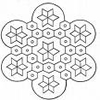 Muggu
is also called Rangoli is one of the most popular art forms in India.
It is a form of sand painting decoration that uses finely ground
white and colored powders, and is commonly done outside homes in
India. These colorful designs are usually drawn on the path near
the entrance to a house. Muggu is created from a series of geometric
shapes and is usually made from paint, chalk, colored powder, petals
rice or sand. Muggu
is also called Rangoli is one of the most popular art forms in India.
It is a form of sand painting decoration that uses finely ground
white and colored powders, and is commonly done outside homes in
India. These colorful designs are usually drawn on the path near
the entrance to a house. Muggu is created from a series of geometric
shapes and is usually made from paint, chalk, colored powder, petals
rice or sand.
Natakam (Andhra Natakam) is a Telugu drama. It
is used to be main form of entertainment before the Telugu movies
and TV channels. Natakam is generally play in two different types
Padya Natakam play with special style of songs and Gadya Natakam
is a drama without songs.
Oggu
Katha (Voggu Katha) is a story-narrating art used in
villages of Telangana region. The Oggu performers narrate the stories
of Mallanna and Beerappa and Shakti ballads, of Yellamma. The team
consists of four to six members. The chief narrator, an assisting
narrator, at least two instrumentalists - one playing on a big drum
called 'rana bheri' and the other on brass talas of a big size.
Paaraani is a red colored decoration on bride's
feet. This is one of the most important makeups of the Telugu bride.
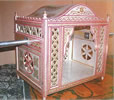 Pallaki
(Doli, Palki, Phalki)is a palanquin traditionally made of wood and
decorated with jewels. Pallaki is used to carry bride to the marriage
stage and carry the bride and groom from the marriage stage but
decorated cars are replaced Pallaki nowadays. Pallaki
(Doli, Palki, Phalki)is a palanquin traditionally made of wood and
decorated with jewels. Pallaki is used to carry bride to the marriage
stage and carry the bride and groom from the marriage stage but
decorated cars are replaced Pallaki nowadays.
Poola Jada is a long hair plait decorated with
flowers. Telugu girls decorate thire long hair tail/plait with flowers
in occations like birthdays and marriages. This one of the important
traditional decorations of the Telugu brides.
Puttentrukalu Teeyadam (Kesa Khandanam, Mundan
ceremony, Tonsure) is a Head-shaving ceremony of a child, this ceremony
is not celebrated on a grand scale and are usually small events
within the family. This ceremony is usually performed at the temple
(sometimes along with ear piercing for the female child).
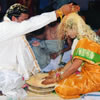 Talambralu
is a Telugu marriage custom in that the bride and the groom shower
one another with Talambralu (rice mixed with saffron & turmeric,
rich people may use pearls instead of rice). This denotes the couple’s
desire for happiness, enjoyment and contentment. Initially they
take turns to shower the rice as it progresses it gets more entertaining
when they begin to compete with each other. Talambralu
is a Telugu marriage custom in that the bride and the groom shower
one another with Talambralu (rice mixed with saffron & turmeric,
rich people may use pearls instead of rice). This denotes the couple’s
desire for happiness, enjoyment and contentment. Initially they
take turns to shower the rice as it progresses it gets more entertaining
when they begin to compete with each other.
Tolu Bommalata (Shadow puppetry) has for ages
been a popular mode of entertainment in rural AndraPradesh. Leather
puppetry in Andhra Pradesh is famous for its life-size images(2-4
meters), highly intricate ornamentation, brilliant colours, rich
style of singing, and adoption of Yakshaganam texts to present full-length
theatre. It is one of the earliest Telugu folk theatre forms which
contained in it the "live" potential of a stage performance
and the engaging luminosity of a colour film.
Utti-Pandaga is also called Gokulashtami celebrated
on Lord Krishna's birthday in Andhrapradesh. Utti (Curd pot hanged
from the middle two poles) is the main ritual during Gokulashtami.
With all the enthusiasm people gather near the Utti. The other end
of the string to which Utti was knotted would be pulled and released
to tease the hitters. Water preserved in big drums will be thrown
on to the hitters who jump and attempt to hit the Utti. The person
who goes successful in hitting the Utti will be entitled to draw
the money tied above it.
Vadi-Biyyam is an another traditional custom
practiced in mostly Telangana region. At least once in a five years
the parents invite their married daughters and give them gifts with
traditional turmeric rice. They usually do this along with some
other important days like birthdays or marriage days.
Vanabhojanalu (Garden or Forest feast) is a kind
of picnic. Friends and families gather and go on picnic to somewhere
near nice and quieter place outside a city or a town usually in
woods, forests or at picnic spot and spend whole day there. They
prepare foods, sing songs, play games and enjoy the prepared foods.
Veedhi Natakam (Veedhi Bhagavatham, Veedhi Bhagotham,
Bhagothulata, Bayalata) is the most popular folk theatre form of
Andhra Pradesh. Veedhi in Telugu means street. So Veedhi Natakam
is any dramatic performance presented in a street.
Yakshaganam
is a musical play with an emphasis on story-telling, using for its
songs desi-metres. The role player acts different roles without
any change in make-up and costume. |




 Telugu
Culture
Telugu
Culture 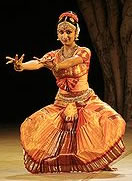 Andhra
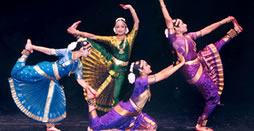
Pradesh has always been known for its rich culture. The wonderful
Andhra (Telugu) state is famous for a wide range of performing arts,
including dance, drama and music, ingenious arts and crafts, and
glorious religions.
Andhra
Pradesh has always been known for its rich culture. The wonderful
Andhra (Telugu) state is famous for a wide range of performing arts,
including dance, drama and music, ingenious arts and crafts, and
glorious religions. 
